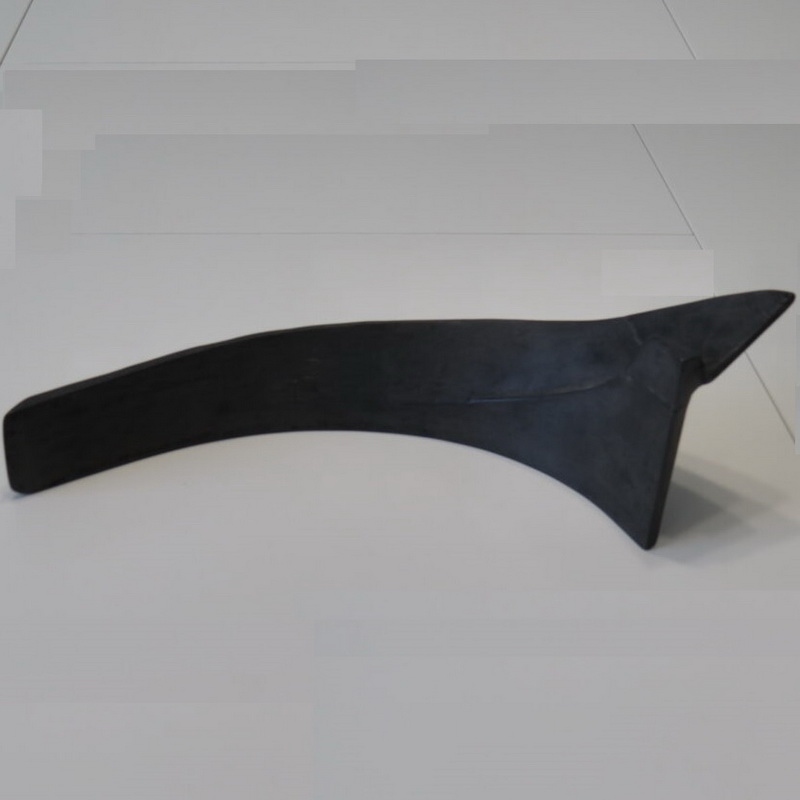


Steel 1.0038 / S235JR
Description:
It is a hot rolled pure structural steel. Having good ductility, toughness and weldability, it has a lower yield strength of 185-235 MPa. This material can be formed into many products such as I-beams, channels, plates, angles, etc.
Its excellent weldability allows it to be widely used in bridges, transmission line supports, etc. It is equivalent to Fe360B. Any steel with similar chemical and mechanical properties can be designated as material S235JR.
| Property | Value, metric system | Density | 7,85 g/cm3 |
|---|---|
| Elongation at break | 21-26% |
| Hardness | 120 |
| Ultimate tensile strength | 340-510 MPa |

Annealing
The annealing process involves heating the metal to a temperature close to the temperature at which recrystallization begins without changing stresses. After heating, the metal is cooled to the furnace room temperature or placed in sand.
End result:
Improved cold workability of metal


Bead blasting
Bead blasting involves spraying a pressurized jet of small balls, plastic or glass, from a nozzle onto the surface of a part. This removes burrs and defects, leaving a smooth surface.
Notes:
The recommended part size is 6-600 mm in height and width. Smaller parts are difficult to hold and difficult to obtain an even surface.
End result:
Homogeneous, matte or satin finish
Slightly grainy to the touch


Black oxidizing
Black oxidizing is a type of conversion coating for ferrous metals such as steel and stainless steel that blackens the top layer of the material. It can be used to reduce reflections and glare, as well as for additional corrosion resistance without affecting part dimensions.

Hardening (carburizing)
A heat treatment process that involves hardening the surface of a metal while leaving the metal underneath soft. As the name implies, carburizing is the introduction of carbon or nitrogen into low-carbon alloys at elevated temperatures, thereby increasing hardenability.

Chemical Nickelizing
Chemical nickel plating provides a uniform nickel coating that protects rough surfaces from corrosion, oxidation and wear.
End result:
Protection against corrosion, oxidation and wear on rough surfaces
Brighter appearance

Through hardening
Through-hardening, also known as pressure hardening, is a heat treatment process used to increase the hardness and strength of a material by heating it to a high temperature followed by rapid cooling, usually by immersion in a hardening medium such as oil, water , or air.
Final result:
A hardened surface layer that is resistant to wear, abrasion and deformation
The core remains strong and ductile

Zinc coating
Galvanizing involves electrodeposition of a thin coating of metallic zinc onto the surface of another metal object, known as a substrate. The zinc coating creates a physical barrier that prevents rust from penetrating the underlying metal surface.
Final result:
Increased resistance to corrosion

Tempering
A heat treatment method mainly aimed at reducing the hardness of metals. It consists of heating the metal to a temperature below the critical point. The temperature is adjusted according to the degree of hardness to be reduced and also varies according to the type of metal.
End result:
Reduced hardness
Increased elasticity and ductility
Reduced yield and ultimate tensile strength